
Prime Minister Narendra Modi and Indonesian President Prabowo Subianto have significantly advanced the India-Indonesia Comprehensive Strategic Partnership, securing crucial agreements on defence, critical minerals, and maritime security, including BrahMos missile supply and Sabang port development.

Indian benchmark indices Sensex and Nifty surged significantly in early trade, mirroring a global rally and a sharp decline in crude oil prices following the finalisation of a peace deal between the US and Iran to end their 107-day conflict and reopen the Strait of Hormuz.

Pakistan Prime Minister Shehbaz Sharif expressed 'forever grateful' to US President Donald Trump for his 'timely' intervention in securing a ceasefire with India following a military conflict last year, a claim India has consistently rejected.

Pakistan has criticised India's recent remarks on Pakistan-occupied Kashmir (PoK) protests, asserting it is addressing issues democratically. Pakistan also warned India against blocking water, calling it an "act of war," and commented on India's nuclear capabilities and its own military strikes in Afghanistan.
Iranian Deputy Foreign Minister Kazem Gharibabadi has urged India to take the lead in bringing peace to West Asia, highlighting the UAE's role in stalling BRICS consensus on the conflict. Gharibabadi also discussed a new framework with Oman for merchant vessels passing through the Strait of Hormuz.

Prime Minister Narendra Modi addressed the Indonesian parliament, emphasising India's commitment to development over expansionism and advocating for a free, open, and inclusive Indo-Pacific. He highlighted the strong historical ties between India and Indonesia, calling for enhanced cooperation in various sectors, including defence, technology, and counter-terrorism, amidst growing concerns over regional security.

External Affairs Minister S Jaishankar has affirmed India's commitment to ensuring issues like a free, open, and rule-based maritime order, seafarer safety, and countering terror financing receive due attention at the UN Security Council during its 2028-29 term.
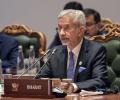
India has expressed serious concerns about the West Asia crisis and its potential impact on energy supplies and maritime stability, urging BRICS nations to find practical solutions to geopolitical challenges and unilateral sanctions.

The harsh truth is that the US is no longer a reliable partner, cautions Ramesh Menon.

Indian benchmark indices, Sensex and Nifty, closed sharply higher, with the Sensex climbing 1,695.40 points and the Nifty surging nearly 2 per cent, driven by a global market rally and a decline in crude oil prices following US President Donald Trump's declaration that his country has ended the war with Iran.

Indian stock markets experienced a significant sell-off, with the Sensex tumbling over 1,300 points, driven by escalating crude oil prices due to US-Iran tensions and Prime Minister Narendra Modi's call for austerity measures, which amplified investor concerns about India's economic outlook.

Indian benchmark indices Sensex and Nifty experienced a significant slump in early trade, mirroring a sharp decline in global equities and a fresh spike in crude oil prices, exacerbated by simmering tensions in West Asia and a global unwinding of the AI-led rally. Track how sensex, Nifty fared on June 8.
Indian equity benchmark indices, Sensex and Nifty, tumbled nearly 2 per cent for the fourth consecutive session, driven by elevated crude oil prices, escalating US-Iran tensions, unabated foreign fund outflows, and a depreciating rupee.
Indian equity benchmark indices, Sensex and Nifty, tumbled nearly 2 per cent for the fourth consecutive session, driven by elevated crude oil prices, escalating US-Iran tensions, unabated foreign fund outflows, and a depreciating rupee.

Indian equity benchmark indices experienced a significant drop in early trade, with the BSE Sensex falling over 525 points and the NSE Nifty down more than 164 points, primarily due to rising crude oil prices and ongoing uncertainty surrounding the US-Iran conflict.
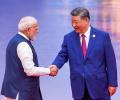
India's dual pursuit of a robust strategic partnership with Washington and a pragmatic, tension-management policy with Beijing represents the essence of modern multi-alignment. By embracing economic pragmatism, learning to compartmentalize political differences, and engaging in continuous dialogue, India can secure its borders, grow its economy, and contribute to a stable, multipolar Asian century, points out Ambassador Rajasekhar.

Indian benchmark stock indices, Sensex and Nifty, closed nearly 1 per cent lower following the collapse of US-Iran negotiations, which heightened concerns of a prolonged conflict in West Asia and drove crude oil prices sharply higher.

A new US intelligence report warns that India and Pakistan's relations remain at risk for nuclear conflict, fueled by terrorism and escalating tensions in the region.

The United States' historical strategic alignment with Pakistan, dating back to the Cold War, has consistently aimed to create a political and military parity with India, despite India's significantly larger size and resources. This long-standing relationship continues to influence regional dynamics, particularly in West Asia and the Indo-Pacific.
National Conference President Farooq Abdullah has voiced his concern over the escalating violence in West Asia, urging all parties to prioritise dialogue and diplomacy to de-escalate tensions and protect civilian lives.

For the foreseeable future, the most likely outcome remains continuation of the status quo. Taiwan will remain self-governing without formally declaring independence, while China continues to apply sustained pressure short of war, predict Krishnan Srinivasan and Manoj Mohanka.

Modi's comments on underlining the importance of ensuring the safety of seafarers came against the backdrop of growing anger in India over the killing of the three Indian crew members in a US military attack on a merchant ship off the coast of Oman last week.
India addresses the escalating conflict in West Asia, outlining its diplomatic efforts to ensure energy security, the safety of its citizens, and advocating for a peaceful resolution through dialogue.
Pakistan on Wednesday welcomed 'the joint reiteration' by the United States and China to promote peace and stability in South Asia. President Barack Obama indicated on Tuesday that the US wants China to help improve relations between India and Pakistan. He reportedly raised the issue during his meeting with Chinese President Hu Jintao in Beijing.

India and Pakistan have managed to "break the ice" on the Asia Cup trophy dispute and will work towards finding a plausible solution in the coming days, BCCI secretary Devajit Saikia said.

Indian benchmark equity indices, the BSE Sensex and NSE Nifty, experienced a significant drop in early trade due to elevated oil prices, weak global market trends, and renewed fears of military operations in the Middle East following US President Donald Trump's statements regarding Iran. Track Sensex, Nifty on May 20.

National Security Advisor Ajit Doval called for decisive action against terrorism and said there cannot be 'double standards' in the fight against it, while addressing an international security forum in Russia.
Indian benchmark indices Sensex and Nifty closed lower, snapping a two-day rally, as a spike in crude oil prices, triggered by reports of fresh US military operations in southern Iran, dampened investor sentiment and reignited fears of renewed energy supply disruptions.

As he settled down to his job as army chief, General Qamar Javed Bajwa -- who died last week; his passing did not merit even an obituary in major print or electronic media in Pakistan! -- developed a vision of reducing his country's and his institution, the army's traditional hostility toward India, points out Rana Banerji, who headed the Pakistan desk at RA&W.
South Asia is likely to remain unstable as long as the Kashmir issue remains unresolved and Pakistan must continue its efforts to find a "just" solution to it, a top Pakistani general has said.
India has joined Brazil and South Africa in calling upon the international community to support the US-sponsored Annapolis West Asia peace conference in order to assist the peace dialogue between Israel and Palestine.

Russian President Vladimir Putin and Chinese President Xi Jinping have reaffirmed their commitment to dismantling global hegemonism and building a 'multipolar world' during high-level talks in Beijing.

India and Israel have elevated their relationship to a special strategic partnership, focusing on enhanced cooperation in trade, technology, and defense, while also addressing regional peace initiatives.
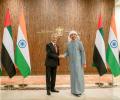
Frankly, was it really necessary in the middle of a fratricidal war for External Affairs Minister S Jaishankar to travel to Abu Dhabi for a one-on-one with the sheikh on April 12?Or, for National Security Advisor Ajit Doval to follow up on April 26? Or, for PM Narendra Modi to follow through today? There are no easy answers, notes Ambassador M K Bhadrakumar.

Indian benchmark indices Sensex and Nifty closed marginally lower due to profit-taking, following the Reserve Bank of India's decision to keep the repo rate unchanged while lowering its growth expectations for the current fiscal year and forecasting higher inflation.

The Quad grouping has expanded cooperation in critical minerals and energy, while unveiling new measures to boost maritime surveillance and port infrastructure across the Indo-Pacific. This move comes against the backdrop of China's growing military posturing in the region, with ministers reiterating strong opposition to destabilising actions and expressing serious concerns over militarisation of disputed features.

US President Donald Trump will visit China from May 13 to 15 at the invitation of President Xi Jinping. The visit occurs amidst global tensions, including the war in West Asia and trade disputes between the US and China. Discussions are expected to cover China-US relations, world peace, and economic issues.

The Congress party has called on the BJP-led government to adopt a unified national approach to restore India's role as a voice for peace, criticising the government's foreign policy and its impact on India's global standing.

Sri Lanka's response to the Easter attacks has been slow and politically contested, unlike India's swift institutional reforms after the 2008 Mumbai terror attacks, observes Colonel R Hariharan (retd).
